
If you’re building in AI or early-stage tech, you’re probably already seeing the shift in Product Engineer hiring. The AI and Tech companies who are seeing the fastest growth are the ones hiring engineers who shape product direction, interrogate user behaviour and move with the urgency of a 0–1 operator.
That’s why the rise of the product engineer matters. And why founders, VCs and technical leaders are treating this role as a key early hire.
1. What Is a Product Engineer?
A product engineer is still an engineer, but the operating system they run on is built around outcomes, not tickets.
Mixpanel describes them as “the bridge between software engineering and product development”
Atlassian frames them as engineers who “discover and solve customer problems, not just implement requirements.”
In practice, the best product engineers:
- Write full-stack or front-heavy code
- Get close to users, data and behaviour
- Own features end-to-end, from idea to rollout to iteration
- Move across engineering, product and design without losing pace
They’re the engineers who ask why, and then architect the how.
2. Product Engineer vs Software Engineer
Here’s the simplest way to break down the difference:
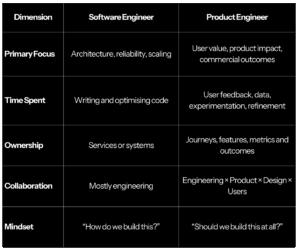
Or, as one industry piece put it:
“Product engineers blur the line between product and engineering — that’s their power.”
3. Why This Role Is Gaining Traction Now
Four forces have pushed product engineers into the centre of modern product teams:
Speed wins markets
The old relay-race of 1) product 2) design 3) engineering collapses under startup pace. High-ownership builders who can do all three accelerate everything.
AI has raised the bar
AI-powered products succeed or fail on UX, not the model. Engineers who think in flows, friction, experimentation and feedback loops now determine product differentiation.
Seed–Series A teams stay lean
Founders are deliberately hiring builders who can wear three hats without slowing execution. Searches for “product engineer” have risen nearly 80% since 2021.
Enterprises feel the alignment gap
Larger companies are correcting the cost of separating product and engineering too far apart. Product engineers have the perfect skillset to close the gap.
4. Why This Matters to VCs, Founders and Talent
Founders
When you compare a strong engineer and a PM versus a single product engineer, the winner for early-stage companies in obvious.
Product engineers shorten iteration cycles, reduce handovers and move teams towards product–market fit with fewer bodies and less overhead.
These are the builders who create the future of tech and AI, not maintain what already exists.
VCs & PE
When you evaluate execution risk, look at the engineering DNA. Teams built around product engineers show:
- Higher experiment throughput
- Faster roadmap movement
- Sharper user feedback loops
- Better early product velocity
These behaviours predict how a team scales and whether it can operate with a true startup mentality.
Top Talent
If you’re an engineer who wants to influence the what, not just the how, this is the role. You keep your technical depth, but gain ownership of the product outcomes that matter.
It’s why the best builders in New York, London, Berlin and Amsterdam increasingly identify as product-minded engineers.
5. What to Look for in a Product Engineer
The strongest product engineers show the traits that define high-ownership operators:
- They talk to users as naturally as they talk to engineers
- They own outcomes, not Jira tickets
- They measure what they deliver
- They make informed decisions quickly
- They move with urgency
- They operate across disciplines without waiting for permission
These behaviours outperform seniority every time.
6. Why Demand Is Surging in AI-Native Teams
AI-native companies operate on a different rhythm:
- Faster build cycles
- Longer experimentation windows
- Tighter, continuous feedback loops
- Constant iteration around UX and edge-cases
AI reduces the cost of building, but not the cost of deciding what to build.
Product engineers collapse that decision cost. That’s why we see demand spiking across London, Berlin, Amsterdam and New York.
These are the operators who take ideas all the way to product.
7. The Takeaway
We’ve been hiring this profile long before the title caught up. Our network across Product, Engineering and AI is full of builders who take companies from zero to on. They’re high-ownership, product-minded, outcome-led operators who do the work that defines early-stage momentum.
Product engineers are becoming the backbone of modern AI teams. They code like senior ICs, think like product owners and operate with the relentless pace of people building generation-defining companies.
If you want to know more about how this role fits into your company, contact us. If you want to know more about taking the next step in your Product Engineering career, talk to us.